Quick answer

Direct answer: A die-cut sticker is trimmed to a defined perimeter instead of remaining a plain rectangle. To quote it well, San Jo Sign Co needs the artwork, finished dimensions, quantity, intended surface, use conditions, and a clear decision about whether the cut follows the art tightly or leaves a deliberate border.

Key takeaways

  • Supply vector logo art when possible and place the contour on its own labeled layer.
  • Small text and narrow protrusions may need adjustment when the finished sticker is much smaller than the source artwork.
  • A border can protect the visual shape, simplify the cut, or improve contrast; it should be a design choice rather than an accidental halo.

Specs & options

Specs

Finished size
Exact width and height measured at the outer cut edge
Cut path
Separate closed vector path with practical corners and internal spacing
Printed edge
Full bleed, clear margin, white border, or another approved edge treatment
Use conditions
Surface, environment, handling, exposure, cleaning, and desired changeover
Versions
Artwork name, quantity, dimensions, and finish recorded for each design

Options

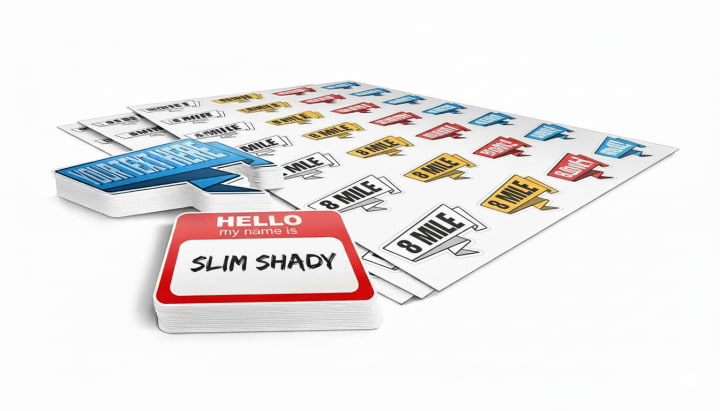
  • A close contour around a simple logo silhouette
  • A consistent border surrounding detailed or irregular artwork
  • Several size versions adjusted for legibility rather than scaled blindly
  • A matte or gloss direction evaluated with the proposed printed construction
  • Variable names or graphics organized in a version schedule

Need help preparing files? See Artwork Setup.

Good fit for

  • Brand stickers handed out at a counter, event, or community activation
  • Package seals and inserts that carry a logo or campaign mark
  • Product, bin, or equipment identification where the customer supplies approved wording
  • Artist and club graphics designed as individual custom shapes
  • A family of coordinated stickers with shared style but different names or icons

How it works

  1. 1) Define the sticker family

    List every design, finished size, quantity, intended surface, use condition, finish preference, and any packaging or sorting requirement.

  2. 2) Build the production file

    Supply vector art or a properly sized raster image with bleed, outlined fonts, and a separate labeled contour path.

  3. 3) Inspect the proof at scale

    Review the actual dimensions, cut edge, border, small type, color, orientation, and version labels rather than judging only a zoomed-in screen view.

  4. 4) Approve the specification

    The final quote connects each artwork version to its material, finish, quantity, production details, and handoff plan.

FAQ

What makes a sticker die-cut?

Its finished perimeter follows a specified custom shape rather than defaulting to a rectangle. The approved proof should show both the printed artwork and the exact outer cut line.

Should the cut follow every tiny detail in my logo?

Not always. Narrow points, tight interior spaces, and isolated elements may be impractical at the requested size. A simplified contour or consistent border can preserve the overall mark more clearly.

What artwork should I provide?

AI, EPS, PDF, or SVG vector art is preferred for logos and cut paths. Properly sized PNG, JPG, TIFF, or PSD artwork may support printing; type should be outlined and the contour clearly labeled.

What is the difference between a die-cut and a kiss-cut sticker?

The terms describe which layers are cut and how the sticker is presented on its backing. Tell us whether you expect separate loose shapes or shapes carried on a larger backing so the construction can be defined in the quote.

Can one order contain several sticker designs?

A multi-design project can be reviewed when each version has a final file, dimensions, quantity, and clear filename. A simple schedule prevents artwork and counts from being mixed between versions.

How do I choose a sticker material?

Describe the application surface, indoor or outdoor setting, handling, exposure, cleaning, expected changeover, and desired appearance. San Jo Sign Co will propose a construction for approval rather than assuming one stock fits every use.