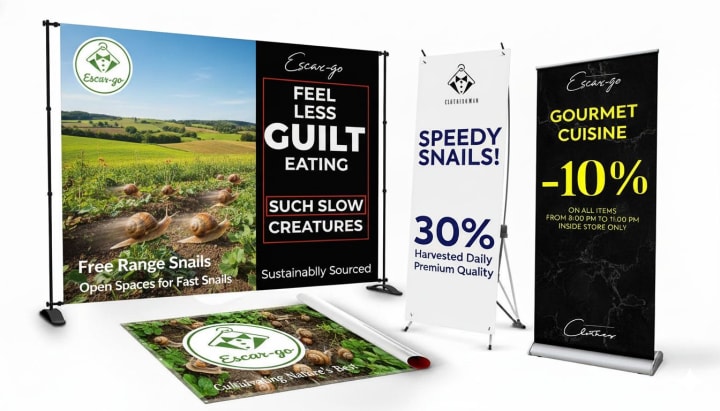
Choosing retail banners

Retail banners work best when each one gives shoppers a clear message at a specific location. A storefront banner might announce a sale, while an interior banner identifies a department or offer. Send approved promotional wording, dates, sizes, quantities, and display photos to scope the printed graphics and finishing.

Key takeaways

  • Name the question a shopper has at each placement; if two questions compete, split the communication job.
  • Keep shared visual rules in a campaign master while tracking local wording and proportions as controlled variants.
  • Assign an update owner and expiry trigger before release so obsolete promotion copy has a defined next action.

Retail banner messages, sizes & placement

Artwork and display details

Decision point
Exact position in the shopper route and the choice or action the banner should clarify
Approved content
Offer, date, exclusions, destination, required text, and call to action supplied by its owner
Variant key
Location, dimensions, language, promotion window, and proof identifier for each output
Display observation
Measured space, viewing behavior, nearby messages, fixture limits, and property rules
Lifecycle owner
Person responsible for release, placement coordination, correction, retirement, and archive

Campaign artwork options

  • Keep one campaign master while giving each decision point its own content brief
  • Adapt proportions from the approved hierarchy instead of stretching a finished layout
  • Separate stable identity from offer details that carry a date or frequent revision
  • Compare a banner request with a window graphic or freestanding sign when the display rules demand it
  • Require quote confirmation for construction, finishing, support, installation, and production timing

Attach the authorized campaign master, reference views, and clearly named source files. The artwork setup guide outlines the package to prepare for review.

Example retail banner locations

These planning examples are not customer or project claims. They show why position, question, approval state, and update responsibility should be recorded before a physical specification is requested:

  • An entrance where the immediate question is whether the current offer applies
  • A transition between departments where a shopper needs one clear route cue
  • A temporary selling area that must identify itself without implying permanent tenancy
  • A queue or collection point where the next action needs to be stated before arrival
  • A multi-destination campaign whose approved details differ by location or release window

From promotional artwork to banner production

  1. 1) Walk the shopper route

    List the questions encountered from approach through exit. Photograph and measure only the proposed banner positions, noting nearby messages and display restrictions.

  2. 2) Assign one decision

    For each position, name the reader, the approved information, and the next action. Move unrelated offer details to another row rather than shrinking them together.

  3. 3) Build the variant register

    Connect every proof to its location, proportions, exact copy, promotion window, quantity, and content approver. Resolve mismatches before authorizing output.

  4. 4) Hand off the lifecycle

    The quote records included production and installation scope. The customer then assigns release, correction, replacement, removal, and archive responsibilities.

Retail and sale banner questions

What is a shopper decision point?

It is a place where a person needs one answer before continuing, such as whether to enter, where to turn, what an approved offer includes, or where to collect an order.

Who owns prices, dates, exclusions, and promotional terms?

The customer’s authorized content owner does. Supply the exact approved language and required disclosures; San Jo Sign Co does not create or validate the underlying commercial offer.

Can the campaign master be resized for every banner?

It can guide the variants, but each proportion needs a fresh hierarchy check. Track the resulting proof as its own output rather than treating a stretched master as approved artwork.

How should several locations be organized?

Give each output a variant key containing its destination, dimensions, exact copy, promotion window, quantity, and approver. Do not release rows that still contain placeholders or conflicting data.

What happens when campaign information changes?

The named content owner issues corrected copy and identifies affected variants. Production or replacement begins only after the changed proof and any revised quote scope are approved.

Does this page specify banner material or installation?

No. Share the measured display, access information, property restrictions, expected use, and responsibility boundaries so construction, finishing, installation, and timing can be stated in the quote.

Get a quote for your sign

Send your artwork, approximate size, quantity, deadline, and a photo of where the sign will go. Include a delivery ZIP code for shipping or an installation address for site work.

We fabricate custom signs and offer direct shipping nationwide. For sign installation in San Jose and the Bay Area, we review the surface, access, and mounting requirements with your project.

Start your sign project · Prepare your artwork · San Jose sign services